Time is Money
Usually this saying is frequently used to highlight that if you take time to execute a task, you are wasting time and, therefore, money. It is because people link working time with pay, which is a legitimate argument.
In procurement, allocating enough time leading to effective procurement processes is not ‘time-wasting’ but a valuable exercise to ensure the best decision in the company's interest.
One of the top annoying statements procurement managers face is, “Got a deal, can you create a PO (purchase order)”? Or “Please create a PO for this”. When such requests are purely an administrative process, it is not a lousy practice as such, as in a dynamic and organised company structure, a PO should cover all goods and services. Therefore, procurement in such instances is acting as a person/department ensuring proper bookkeeping processes.
However, when the process is continuously used to cut corners, it can be dangerous with consequences for the business. Abdicating from a structured procurement process can at first glance look like a faster execution. Typically, people from the operation might fall into this trap, genuinely intending to get things done “expediently”.
Referring to the below diagram, ‘What people don’t see’, such tasks are omitted when managers/decision makers decide to exclude the procurement expertise from decision-making. A picture can be portrayed that “I did it all”. All we need is to raise a PO. Alternatively, it can be presented as “I took this on me to save you time”—a big no. The function of Procurement Managers is to whilst being efficient; they also need to ensure that all processes were effectively executed. The tasks “below water” in the diagram should always be respected. Failing to implement such processes can give faster results. However, one question one should ask is, at the expense of what?
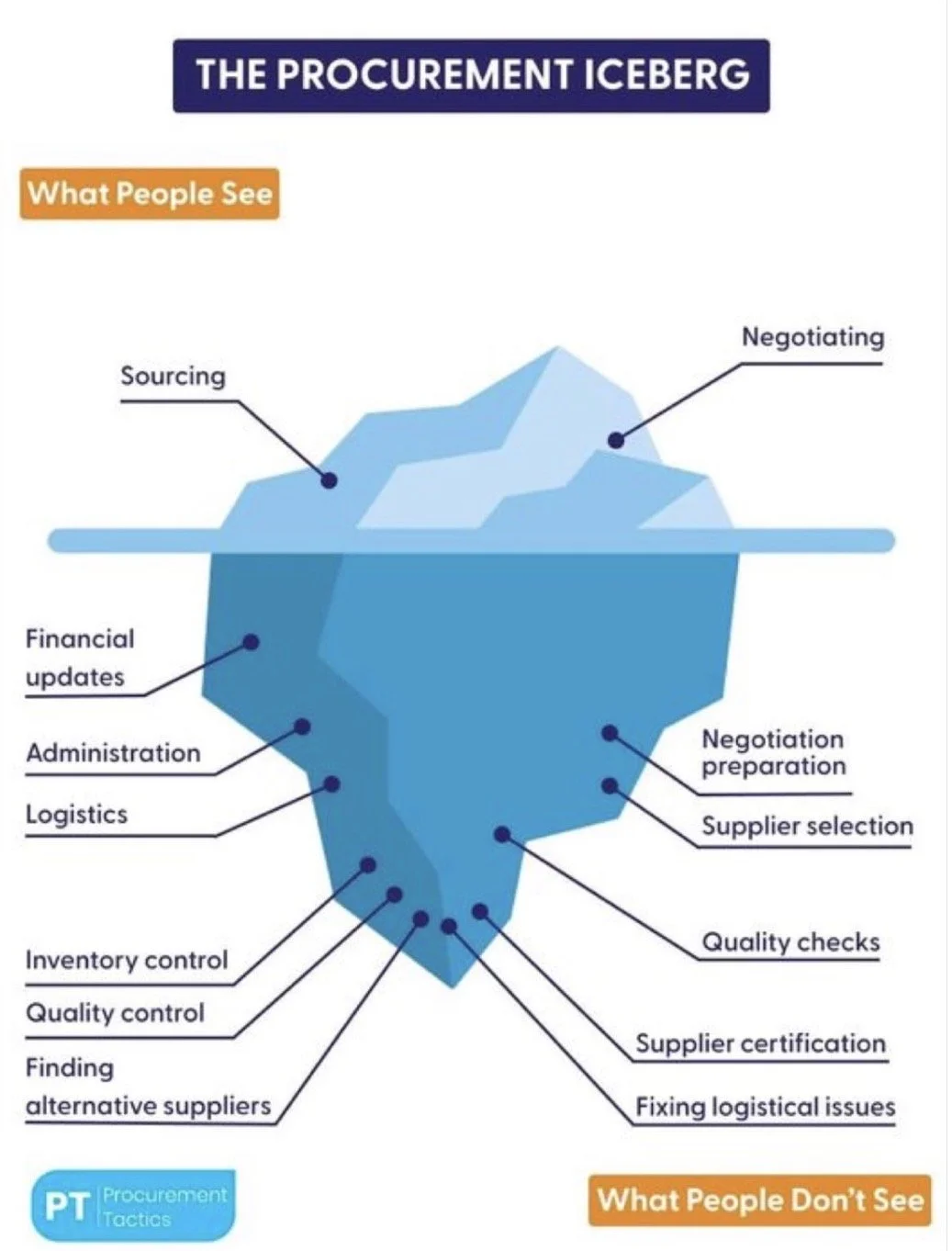
Organisations making good profits will probably decide not to give weight to this question. It might be acceptable and a mere circumstance; however, when such culture is adopted on a larger scale, it can be detrimental. Organisations might be absorbing extra and hidden costs, incremental costs which can be mitigated by applying good procurement processes.
Consequently, the question would become, “Can we do better?”
How can you achieve this?
i) Plan
ii) Explain your requirements in detail
iii) Assign the task through the proper channels
iv) Ensure that procurement is given enough time to execute the proper processes
v) Follow up
vi) Once goods and services are delivered, give constructive feedback to procurement.
An effective and efficient process can only be achieved by understanding the underpinning advantages procurement expertise can bring to the table.
This can only be achieved by planning. Planning needs time. An effective procurement process requires time, and so:
TIME IS MONEY